
There is no fixed price list for a marshes day trip from Basra. Costs depend on how you arrange transport, which boatman you find, and what you negotiate before you leave the shore. Based on traveler reports, a day trip — covering a private car to Chibayish, a boat ride, and lunch — can run anywhere from under USD 30 to over USD 80 per person. Always agree on the full price, in Iraqi dinars, before you board anything.
What You’re Actually Paying For
A marshes trip from Basra has four or five separate cost components. None of them have posted prices, and combining them without confirming each in advance is where budgets spiral.
1. Transport: Basra to Chibayish
The main visitor gateway to the Mesopotamian Marshes — a UNESCO World Heritage Site — is Chibayish, roughly a three-hour drive from Basra (reported by thingstodoiniraq.com). Hotels in Basra can arrange private cars directly; you can also negotiate with drivers independently. Check with your hotel or operator for current rates — do not assume a price from last year still applies.
If you’re booking transport independently, see Getting Around Basra for general guidance on hiring drivers in the city.
2. The Boat Ride
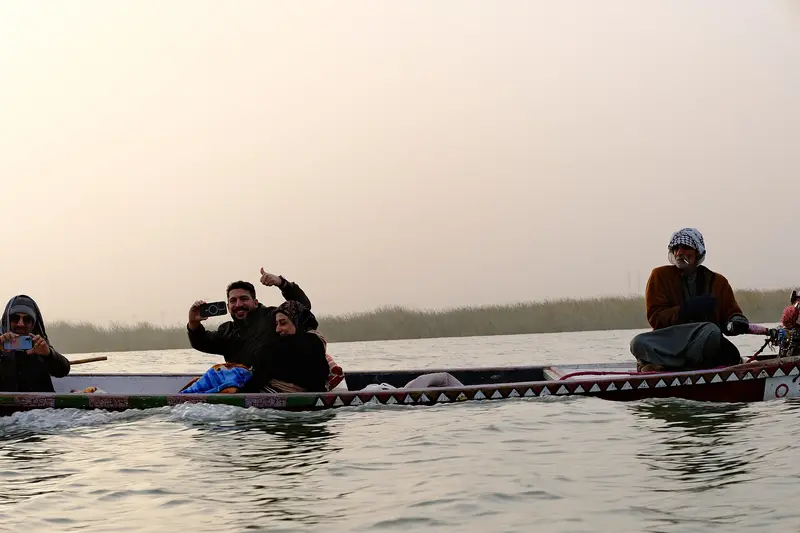
You’ll travel the marshes in a mashoof — a traditional narrow wooden canoe, usually motorised. Reported rates from travelers:
- 25,000–35,000 IQD per boat per hour — independent traveler reports (thingstodoiniraq.com; quitandgotravel.com)
- 25,000–50,000 IQD per boat for a one-hour trip with tea in a mudhif (traditional reed guesthouse) — iraqtourism.org
- 25,000–30,000 IQD for a short (~30-minute) ride for foreigners — theglobetrottingdetective.com
All figures are traveler-reported; check current prices with your operator. At the current exchange rate of approximately 1,312 IQD per USD (ExchangeRate-API, fetched 2026-08-09), 35,000 IQD is roughly USD 27 — but these rates shift and the exchange applies to guideline context only.
Negotiate before departure. “Short trip” is loosely defined; agree on the total duration and confirm what the price covers before the boatman casts off.
3. Meals and Mudhif Visits
- One group paid 20,000 IQD for a family dinner served in a traditional mudhif reed house (dinotruck.com) — on top of a separate 40,000 IQD for two hours on the water.
- A TourHQ-listed 9-hour guided day tour from Basra lists lunch and boat trips at USD 30 per person — check the operator’s current pricing at tourhq.com.
4. Packaged Options
If you prefer one bill rather than separate negotiations:
- A package covering one night’s accommodation, dinner, a mudhif visit, and a 3-hour boat trip cost two travelers 140,000 IQD total (approximately USD 95 / €87 at the time of booking) in the Chibayish district — theglobetrottingdetective.com. Verify current pricing with the operator; this is a traveler-reported figure.
- Iraq Travel & Tours offers a 2-day overnight marshes adventure departing from Basra, including boat travel, an overnight stay in a traditional reed house, and a traditional breakfast with a local family (iraqtravelandtours.com). Check with them directly for current prices and availability.
Cash and Money
There is little to no card acceptance in or around the marshes. Bring Iraqi dinars in small denominations — 1,000 and 5,000 IQD notes are practical for tips, tea, and small purchases. Large notes may be difficult to break on site.
Do not count on an ATM once you leave Basra’s main districts. For full guidance on exchanging money and cash logistics, see Money in Basra.
Packing Checklist
Pack light. One experienced traveler specifically recommends leaving large luggage at your hotel and bringing only a small daypack (laurewanders.com).
Essentials:
- ☀️ Sun protection — hat, sunglasses, high-SPF sunscreen. August highs in Basra reach 46–50 °C (Open-Meteo normals; current 7-day forecast peaks at 50.6 °C on 2026-08-13). The marshes offer little shade on the water.
- 🦟 Insect repellent — mosquitoes are active, especially near reed beds and at dusk.
- 💧 Water — bring more than you think you need, plus water purification tablets. Trips can stretch for hours and safe drinking water is not guaranteed on site (thingstodoiniraq.com).
- 📱 Power bank — phone signal drops quickly inside the marshes (thingstodoiniraq.com); you won’t be charging anything out there.
- 🗺️ Offline maps — download before you leave Basra. Google Maps or Maps.me both allow offline areas (thingstodoiniraq.com).
- 👕 Quick-dry, modest clothing — lightweight long sleeves protect against sun and insects and are appropriate in a traditional community. Avoid tight or revealing clothing.
- 🔦 Headlamp — essential if you’re staying overnight; bring spare batteries.
- 🛄 Dry bag — for your phone, documents, and anything that can’t get wet. Mashoofs sit low in the water.
- 🍫 Snacks — especially on day trips where meal timing is uncertain (thingstodoiniraq.com).
Optional:
- Binoculars (see Basra Marsh Bird-Watching Seasonal Guide if wildlife is your main draw)
- Small notebook and pen — useful when language gaps mean writing numbers or directions
What Not to Rely On
- English speakers — guides who speak English exist, but are not guaranteed at the waterside. Arranging a guide in advance is a better bet than finding one on arrival.
- Fixed schedules — boats do not run to timetables. Early starts avoid peak heat, but nothing is guaranteed.
- ATMs or card readers — there are none in the marshes area. Sort your cash before leaving Basra.
- Consistent pricing — traveler reports vary significantly; prices change. Use the figures above as rough orientation, not a budget you can lock in.
How to Pin Down Your Actual Cost
- Book transport in advance through your hotel or a tour operator — confirm whether the price includes waiting time while you’re on the water.
- Ask for a package price covering transport, boat, and at least one meal if you’re going through an operator. It’s often simpler than assembling each piece separately.
- Agree the boat price, duration, and exactly what’s included with the boatman before boarding. Write down the agreed number if there’s a language gap.
- Budget a tip — not obligatory, but customary and appreciated. Small notes make this easy.
- Confirm everything again the morning of — arrangements in the marshes area can change.
For full trip context and what to expect on the drive out, see Mesopotamian Marshes from Basra. For accommodation before or after your trip, Where to Stay in Basra covers the main options at different budget levels.
Timing note: The best months to visit are spring (March to early May) or autumn (late September to October) when temperatures are most comfortable (laurewanders.com). If you’re visiting in summer, an early departure from Basra is not a preference — it’s a practical necessity.