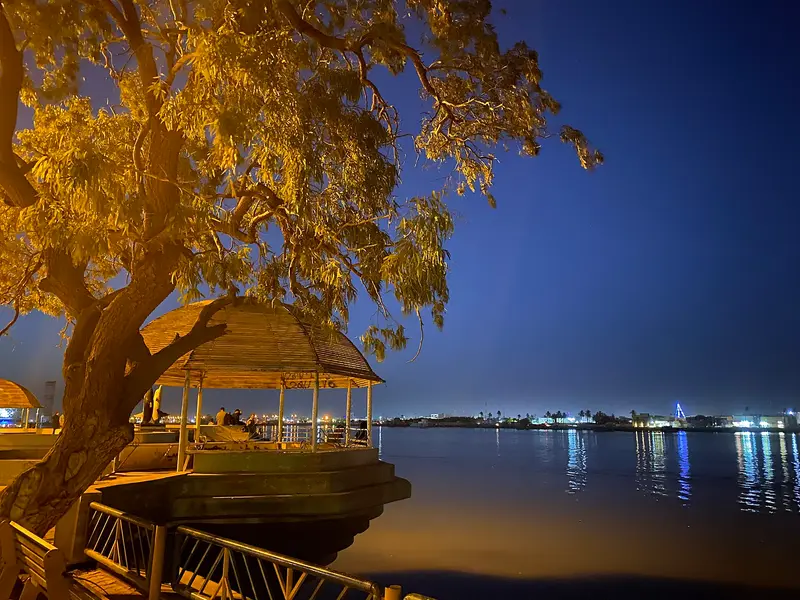
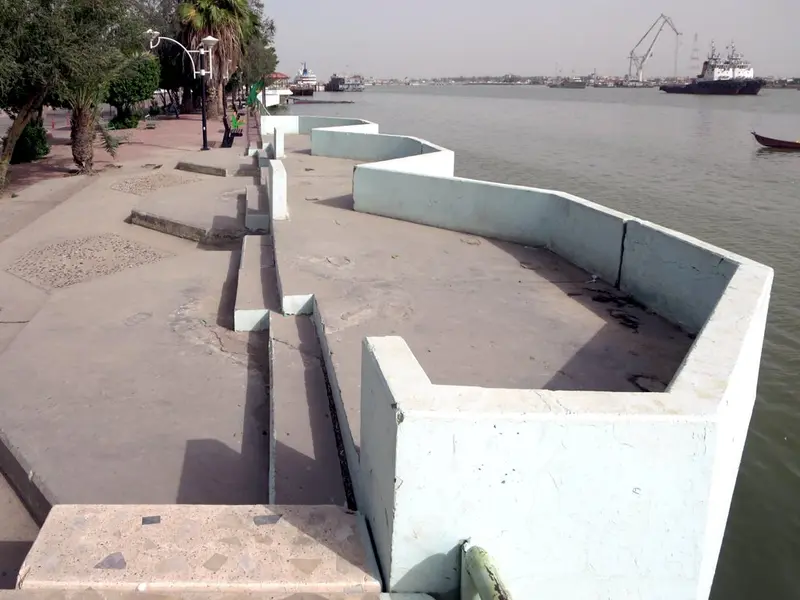
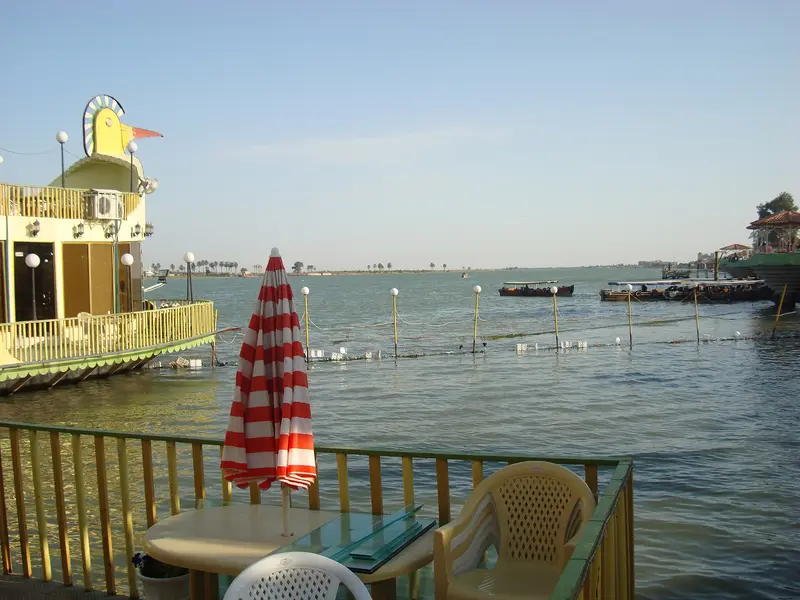
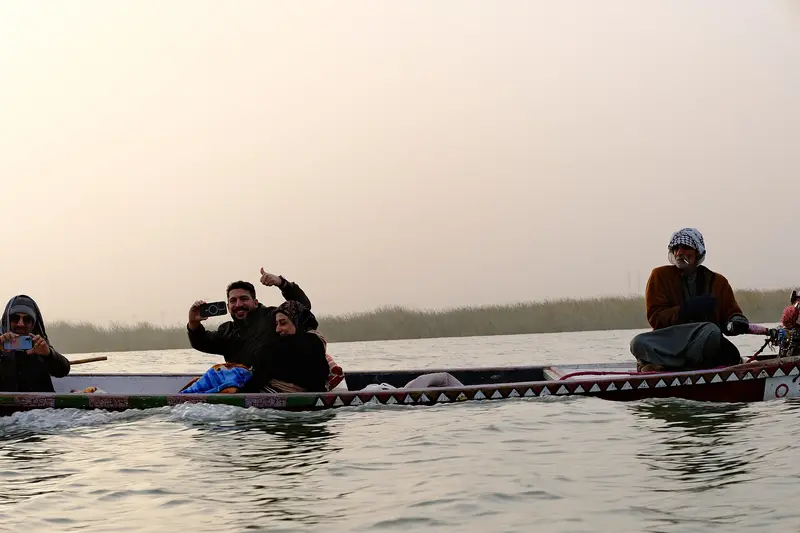

Yes, the Mesopotamian Marshes (الأهوار) work as a day trip from Basra (البصرة). The usual target is Chibayish (الجبايش), a marsh-edge town on the Euphrates roughly two hours by road northwest of the city, where boatmen run trips from the riverfront by the Martyrs Monument (نصب الشهداء). Plan on about nine hours door to door: road time each way, two to three hours on the water, and lunch in a reed house. Spring and autumn are the comfortable seasons; summer is punishing.
This guide covers what the marshes are, how the day actually runs, how to arrange a boat and agree a price, and how to visit without adding to the pressures the wetland is already under.
What the marshes are, in two minutes
The marshes of southern Iraq — often called the Mesopotamian Marshes or, in Arabic, the Ahwar — are the wetlands of the lower Tigris (دجلة) and Euphrates (الفرات). They were once the largest wetland system in western Eurasia, and they remain the home of the Ma’dan (معدان), the Marsh Arabs, whose reed guesthouses (mudhif, مضيف), water buffalo herds, and slim mashoof (مشحوف) canoes define the landscape as much as the reeds do.
In 2016 UNESCO inscribed the area on the World Heritage List as The Ahwar of Southern Iraq: Refuge of Biodiversity and the Relict Landscape of the Mesopotamian Cities. It is a mixed natural-and-cultural property with seven components: four marsh areas — the Huwaizah Marshes, the Central Marshes, and the East and West Hammar Marshes — plus three Sumerian archaeological sites, Uruk, Ur, and Tell Eridu.
Chibayish is the practical gateway. The town sits on the Euphrates in Dhi Qar governorate, has long been a hub for Marsh Arab communities, and is a traditional building centre for the mashoof canoes you will ride. From its waterfront, boats reach the marsh areas around the town, water levels permitting.
One piece of context worth carrying with you: the marshes were largely drained in the late twentieth century, partially reflooded after 2003, and have been squeezed hard by drought in recent years. The United Nations in Iraq reports that buffalo herds have fallen by more than 76 percent in the recent water crisis. What you see on any given visit depends heavily on that year’s water.
Marshes day trip at a glance
- Base town
- Chibayish (الجبايش), Dhi Qar governorate
- Boat launch
- Riverfront by the Martyrs Monument, Chibayish
- Typical day from Basra
- About 9 hours door to door
- Time on the water
- 2 to 3 hours is the standard trip
- Best months
- March to early May; late September to October
- Payment
- Cash in Iraqi dinars — agree the price before boarding
Where Chibayish is, relative to Basra
Chibayish lies roughly 100 kilometres northwest of Basra, on the south bank of the Euphrates between marsh components of the UNESCO property. It is closer to Nasiriyah (الناصرية) — about a 90-minute drive from that city — which is why many published guides describe the marshes from the Nasiriyah side. Coming from Basra you simply approach from the opposite direction, and you gain one bonus: the route passes Al Qurnah (القرنة), the town at the confluence of the Tigris and Euphrates, which Basra day tours often include as a stop.
Budget around two hours of driving each way from central Basra, and more in poor traffic. There is no rail or formal bus link to Chibayish itself, so the trip is by road whichever way you slice it.
How the day trip works
Option 1: an organised tour from Basra
The simplest version is a package with hotel pickup. One published Basra itinerary runs nine hours — pickup at 9:00, back by 18:00 — and includes transport, an English-speaking guide, a boat trip through the marshes, lunch with a Marsh Arab family, and a stop at Al Qurnah on the way. On that listing the boat-and-lunch element is priced at about 30 US dollars per person, with the vehicle and guide priced for the group, so get a full written quote for your party size before committing. Iraqi operators also sell two-day versions from Basra with a night in a reed house, listed from about 499 US dollars per person. Prices and inclusions change; check with the operator.
Tours are worth the premium mainly for the interpreter. The families you meet in the marshes rarely speak English, and a guide turns a scenic boat ride into an actual conversation.
Option 2: independently, with a boat arranged on arrival
Plenty of travellers do this trip without a tour. The pattern that works:
- Arrange a car and driver for the day through your hotel — see getting around Basra for how drivers and day rates work. Alternatively, intercity shared taxis running the Basra–Nasiriyah corridor can drop you in Chibayish, but confirm the drop-off with the driver before boarding and think through your return leg; services back are informal. For reference, on the Nasiriyah side shared taxis to Chibayish were reported at about 5,000 dinars and private taxis at about 25,000 dinars in early 2026.
- Head for the Martyrs Monument on the Chibayish riverfront. This is the established boat launch. Travellers report that staff at the post there will phone a local boatman for you if none is waiting; expect a short wait, often around ten minutes.
- Agree the route, the duration, and the price before you get in the boat. Two to three hours is the standard trip and enough to reach buffalo farmsteads deep in the reeds.
Have your phone charged, an offline translation app loaded with Arabic, and offline maps downloaded — sorting your SIM and apps is covered in your first 24 hours in Basra.
What happens on the water
Trips use either a paddled mashoof or, more commonly for visitors, a motorised launch of the same slim shape. A typical loop threads reed corridors, passes floating and island farmsteads where water buffalo wallow, and stops for chai with a marsh family. Many hosts offer lunch in a mudhif — the classic order is masgouf, butterflied river fish grilled by an open fire. Sunset from the boat is the photograph everyone leaves with; if that is your goal, run the trip late in the day and confirm the return drive with your driver first.
Arranging a boatman and agreeing a price
There is no posted tariff at the launch, so treat pricing like any negotiated service in Iraq: settle it up front, per boat rather than per person where possible, and in writing on a phone screen if language is a barrier.
Recent, sourced reference points, all from late 2025 and early 2026: a family boatman quoted about 50,000 Iraqi dinars for an overnight package for two people that included lunch, a masgouf dinner, breakfast, a bed in the family home or mudhif, and unlimited boat rides. The best-known boatman in Chibayish, Abu Haider, charges around 150,000 dinars — roughly three times the going rate — largely on the strength of his reputation. A shorter day-trip boat ride costs less than an overnight package; there is no reliable published figure, so agree it on the spot and check with the operator if you booked ahead.
Bring more cash than you think you need, in dinars and in smaller notes — there are no card payments in the marshes and no reliable ATM stop once you leave the highway. Our money in Basra guide covers where to withdraw and exchange before you set off.
Best season, and what to bring
Timing matters here more than almost anywhere else in southern Iraq, because you will be on open water with no shade.
- Spring (March to early May): the best window. Daytime temperatures around 25 to 35 degrees Celsius and little rain.
- Autumn (late September to October): the second-best window, roughly 22 to 33 degrees.
- Summer (mid-May to mid-September): temperatures can pass 50 degrees. If you are reading this in July and going anyway, negotiate a dawn start, stay off the water between late morning and late afternoon, and carry far more drinking water than feels reasonable.
- Winter (November to February): the rainiest months, with daytime highs around 18 to 27 degrees and cold nights, especially if you sleep in a reed house.
Basra weather by month
| Month | Avg high (°C) | Avg low (°C) | Rain (mm) |
|---|---|---|---|
| Jan | 18 | 7 | 32 |
| Feb | 21 | 9 | 22 |
| Mar | 26 | 13 | 18 |
| Apr | 33 | 19 | 13 |
| May | 39 | 24 | 4 |
| Jun | 44 | 28 | 0 |
| Jul | 46 | 30 | 0 |
| Aug | 46 | 29 | 0 |
| Sep | 42 | 25 | 0 |
| Oct | 36 | 20 | 3 |
| Nov | 26 | 13 | 19 |
| Dec | 20 | 9 | 26 |
Open-Meteo · as of
Packing list for a day trip: sun hat and sunglasses, high-SPF sunscreen, insect repellent, drinking water, a power bank, cash in dinars, and clothing that is modest and quick-drying. Footwear you can slip off easily is useful — you will step in and out of a low boat, and shoes come off in homes and mudhifs. Overnighters should add a headlamp, toiletries, and realistic expectations: sleeping is on thin mats on the floor, and facilities are basic.
Women travellers generally dress conservatively here, as elsewhere in southern Iraq — covered shoulders and knees at minimum; a headscarf is not required for foreign visitors in the marshes but is handy to have.
Visiting responsibly
The marshes are a working landscape under real strain, not a theme park. A few habits keep your visit a net positive:
- Put money into the community. Eat the lunch, drink the chai, pay the boatman fairly rather than grinding out the last dinar. With herds shrinking and households under pressure, visitor income genuinely matters.
- Ask before photographing people, especially women. A gesture with your camera and a raised eyebrow works across any language gap.
- Do not ask the boatman to chase buffalo or flush birds for a photo. The marshes are significant bird habitat — part of why UNESCO listed them under natural criteria.
- Take every piece of your rubbish back to Basra. There is no waste collection in the wetland.
- Accept hospitality graciously and reciprocate sensibly — sharing dates, fruit, or tea you brought goes down well; handing out money or sweets to children does not.
Day trip or overnight?
If your base is Basra, the nine-hour day trip is the standard play, and it fits neatly into a longer stay — pick a hotel with an early breakfast or a flexible front desk; see where to stay in Basra. The overnight adds the sunset ride, the masgouf dinner, and a night in a mudhif, at the cost of basic sleeping conditions and a second day. Travellers heading onward to Nasiriyah, Ur, and points north can treat Chibayish as a natural mid-point rather than backtracking.
Either way, the marshes are the single most distinctive excursion you can make from Basra — a wetland civilisation a couple of hours from the city. For the rest of our coverage of the region, start at the marshes hub.