
Getting around Basra (البصرة) day to day comes down to three tools: ride-hailing apps, street taxis, and — for business travelers — a private driver. Careem and Baly both operate in the city and give you a fixed price before you ride, which matters because street taxis are generally unmetered and every fare is a small negotiation. There is no metro, no tram, and no bus network designed with visitors in mind, so plan on cars for anything beyond a single neighborhood.
This guide covers which apps verifiably work in Basra, how to handle street taxis without overpaying wildly, when a private driver is worth it, and where walking actually makes sense.
Your options at a glance
Transport options in Basra
- Careem
- Operates in Basra (one of four Iraqi cities on its official list)
- Baly
- Iraqi super app; Basra is on its published taxi city list
- Saba
- Ride-hailing plus corporate chauffeur service; covers Basra
- inDrive
- Lists Iraq country-wide; check in-app whether Basra appears
- Street taxis
- Everywhere, unmetered; agree the fare before getting in
- Shared minibuses
- Fixed local routes, cash, no published maps; for the adventurous
If you remember one thing: install at least one app before you arrive, because it removes the fare negotiation entirely, and keep small dinar notes on you for everything else. For how to get cash and which notes to carry, see money in Basra.
Ride-hailing apps that operate in Basra
Not every app you know from home works here, and not every app that works in Baghdad works in Basra. Bolt’s public city directory currently lists no Iraqi cities at all. Here is what checks out as of mid-2026.
Careem (كريم)
Careem’s official Iraq page lists four cities: Baghdad, Najaf, Basra, and Erbil. The service runs around the clock, and signing up takes a name and a phone number — a local SIM makes this smoother.
Careem in Iraq offers several ride types: a standard Taxi option, Awfar as its cheapest tier, Extra for rides with multiple drop-offs or hourly booking, and a dedicated To Airport option. That last one is useful on departure day; for the arrival side, see the Basra airport arrival guide.
One quirk worth knowing: when Careem launched in Basra in 2019, it built the service on the city’s existing taxis rather than a separate fleet. So the car that arrives may well be an ordinary local taxi — the difference is that the app has already fixed your price and mapped your route.
Baly (بلي)
Baly is an Iraqi super app founded in 2021 and based in Baghdad, combining taxi booking, food delivery, and parcel delivery. Its published city list for taxi service includes Basra alongside Baghdad, Najaf, Karbala, Hilla, Diyala, Kirkuk, Mosul, and Nasiriyah. The app lets you choose between private cars and taxis, pick a payment method, and use an electronic wallet.
If a driver calls to confirm your pickup point, a few words of Arabic or a hotel doorman who can take the call helps.
inDrive and the rest
inDrive lists Iraq among the roughly 48 countries where it operates but publishes no city-by-city breakdown, so the only reliable test is to open the app in Basra and see whether drivers respond.
As for other big-name apps: if the one you use at home shows no cars when you open it in Basra, that is your answer — switch to Careem or Baly rather than waiting for coverage that may not exist.
Before you ride: data, cash, pickup points
All of these apps need mobile data, so sort out a local SIM early — it is one of the first tasks in your first 24 hours in Basra. Assume cash payment in Iraqi dinars unless the app explicitly confirms another option for your ride; wallets and card payments exist in some apps but are not something to depend on. And because street addressing in Basra is loose, drop a precise pin and be ready to describe your pickup by landmark — a hotel name, a mosque, a well-known shop — rather than a street number.
Street taxis: how to flag one and agree a fare
Street taxis are everywhere in central Basra and along the main corridors. They are generally unmetered — the reason ride-hailing apps advertise upfront pricing in Iraq in the first place — so the fare is whatever you and the driver agree before the car moves. That is the whole game: before, not after.
The routine that works:
- Flag the car and state your destination through the window, by landmark. “Corniche”, “Ashar” (العشار), or your hotel’s name will get you further than a street address.
- Ask the price. If the number sounds inflated, counter or wave the car on — another taxi is rarely more than a minute away in the center.
- Agree clearly, then get in. Repeat the number back if there is any doubt.
- Pay in dinars with reasonably small notes. Drivers often cannot break large bills, and asking for change from a big note after a short hop starts the negotiation over again.
We deliberately do not print sample fares here, because unposted, negotiated prices shift with fuel costs and season and any number we printed would age badly. Get a baseline instead: ask your hotel reception what a ride to your specific destination should cost that week, then negotiate around that figure. Short hops within the center are cheap in dinar terms; cross-city rides cost more; anything involving waiting time should be agreed as a package before you set off.
A note on shared taxis and minibuses: Basra, like other Iraqi cities, has shared minibuses running fixed routes for a small cash fare — locals often call them kia (كيا) after the vans commonly used. There are no published route maps and destinations are called out or posted in Arabic, so treat them as an experience for the curious rather than a dependable tool for a schedule.
Private drivers for business travelers
If you have back-to-back meetings, formal site visits, or hosts expecting you at fixed times, a dedicated driver beats summoning a new car for every leg. You get one vehicle, one phone number, waiting time included, and no repeated pickup-point explanations.
Three ways to arrange it:
- Through your hotel. The international business hotels arrange cars and drivers routinely, and this remains the simplest option for most visitors. Agree the scope — hours covered, waiting time, whether out-of-town trips are included — and the total price in advance. For which hotels handle this well, see where to stay in Basra.
- Through a chauffeur service. Saba, an Iraqi ride-hailing and chauffeur company, operates in Basra alongside Baghdad, Erbil, and Najaf, and offers corporate and executive service, airport transfers with flight tracking, and intercity trips. Its fleet spans sedans seating four, SUVs seating five, and minivans seating six, with 24/7 support by in-app chat, email, and phone. For rates, check with the operator directly.
- Through your company’s local partner. If you are visiting a Basra-based firm, ask them first — most business hosts in the city maintain driver arrangements and will often simply assign you one.
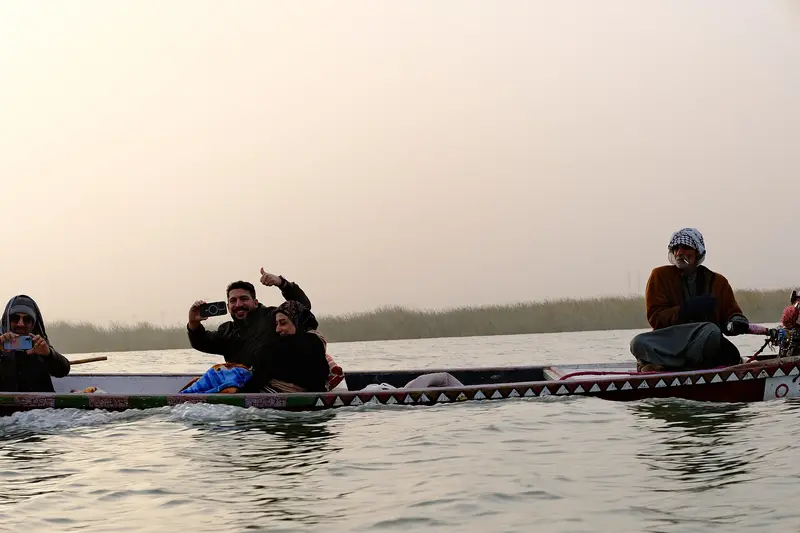
For day trips out of the city — most famously to the Mesopotamian Marshes around Chibayish (الجبايش) — a private driver or an organized tour is the practical choice, since app coverage thins out fast beyond the city. Details in our guide to visiting the marshes from Basra.
Whatever the arrangement, put the essentials in writing, even just a text message: dates, hours, vehicle type, and the agreed total. Ambiguity is where disputes come from, in any country.
Walking and distances
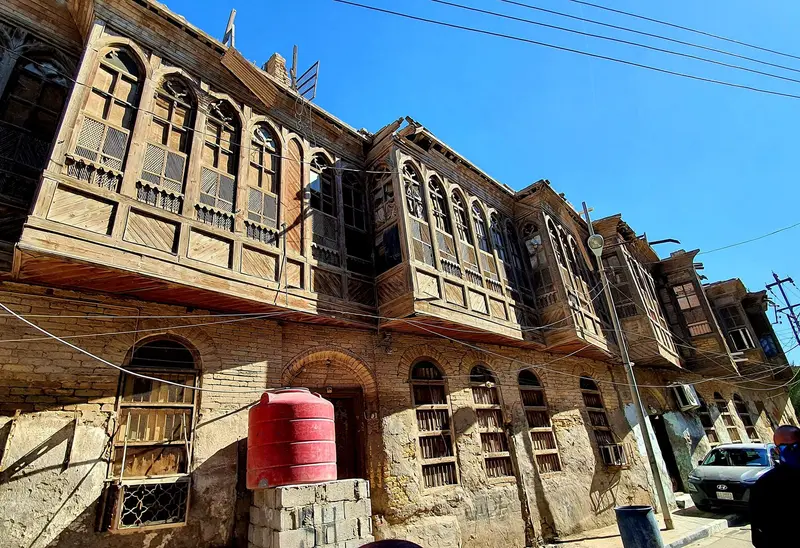
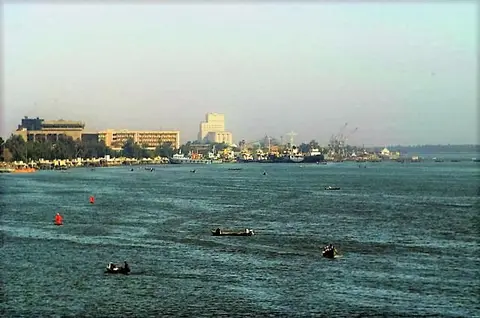
Basra rewards walking in small doses and punishes it in large ones. The city stretches along the Shatt al-Arab (شط العرب) waterway, and its points of interest are scattered: the Corniche riverfront, the Ashar market area, and the old quarter with its shanasheel houses sit close enough to combine on foot, but your hotel may easily be a car ride from all of them.
What to expect on foot:
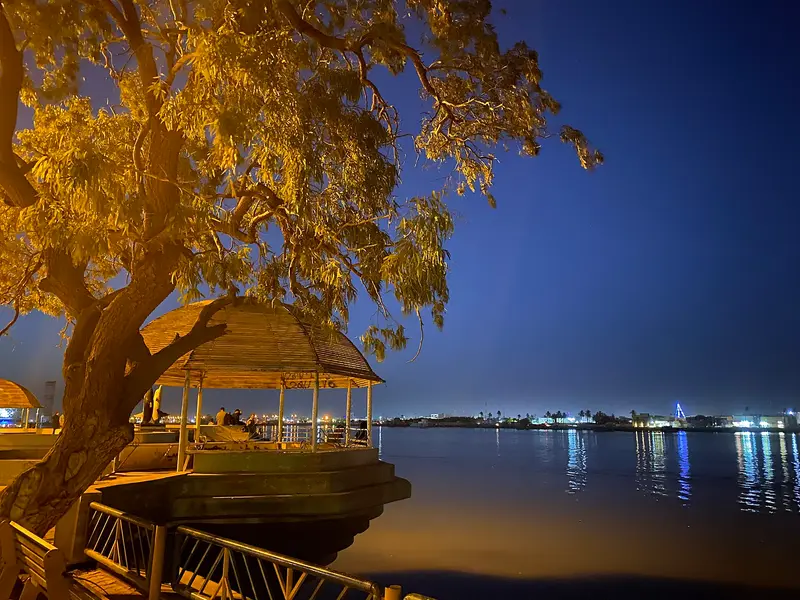
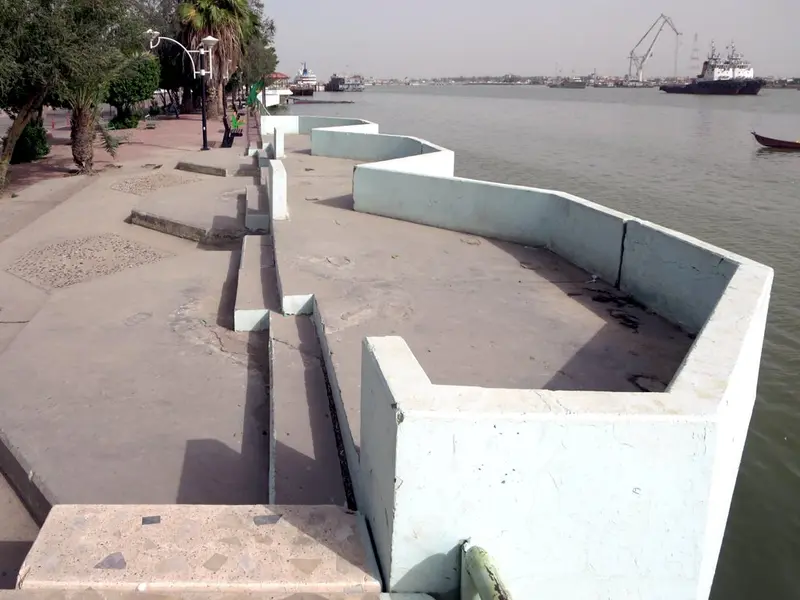
- The Corniche is the best walk in the city — flat, open, and busiest in the evening when families come out.
- Ashar and the old town work as a single walking cluster: markets, the creek, and the surviving shanasheel architecture are within a comfortable range of each other.
- Sidewalks elsewhere are inconsistent — broken pavement, parked cars, and street vendors mean you will step into the road regularly. Crossing multi-lane roads takes patience; do what locals do and cross in groups when possible.
- Heat is the real limit. Basra summers are among the hottest of any major city, and from roughly June to September walking between districts in the afternoon is simply not sensible. Walk early, walk after dark, and take cars in between. Winter, by contrast, is genuinely pleasant walking weather.
A useful rule: if the walk is longer than about twenty minutes on the map, take a car. Ride distances within the center are short, and the time you save compounds across a day.
Common mistakes
- Getting in before agreeing the fare. The single most expensive habit in unmetered taxi cities. Agree first, every time, or use an app.
- Assuming your usual app works. Check coverage before you fly. Careem and Baly are the dependable names in Basra; Bolt’s public city directory lists no Iraqi cities at all.
- Arriving without mobile data. Every app option dies without it. A local SIM in your first hours solves transport, maps, and translation at once.
- Carrying only large notes. Drivers frequently cannot change them. Break big bills at your hotel or a larger shop early and keep a pocket of small dinars for rides.
- Navigating by street address. Landmarks rule here. Know the name of a mosque, market, or hotel near your destination and use that.
- Underestimating the heat. A fifteen-minute walk in July is not the same activity as a fifteen-minute walk in January. Plan car legs for summer afternoons.
- Leaving out-of-town transport to chance. Apps are a city tool. For the marshes, Zubair, or anywhere beyond Basra proper, arrange a driver the day before — through your hotel, a chauffeur service, or your hosts.
Basra’s transport picture is simpler than it first looks: one app installed, one pocket of small notes, one hotel receptionist who knows this week’s fair fares — and the city opens up. Sort those three out on day one and everything after is logistics.