
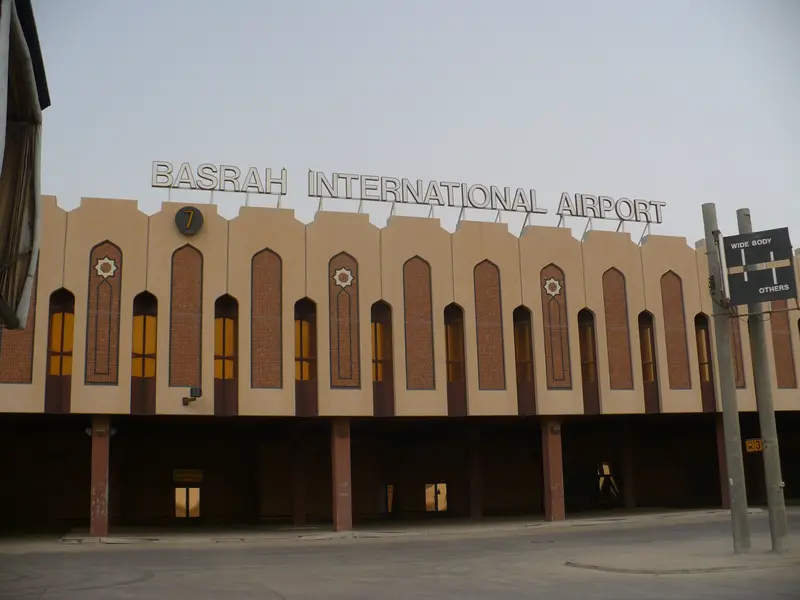
Basra International Airport (مطار البصرة الدولي), airport code BSR, sits about 12 km west of central Basra (البصرة) — a short drive from the Shatt al-Arab corniche and the main hotel district. The one thing to get right before you fly: since 1 March 2025, Iraq no longer issues visas on arrival to most visiting nationalities. You apply for an e-visa online instead. After landing, the sequence is straightforward — immigration, baggage, customs — and then a pre-arranged pickup or airport taxi into the city.
Airport basics
BSR (ICAO code ORMM) is southern Iraq’s main gateway and, by the most recent published passenger statistics, the country’s fourth-busiest airport after Baghdad, Najaf, and Erbil. It handles a modest but useful spread of international routes. Iraqi Airways is the biggest operator, with destinations that have included Baghdad, Dubai, Istanbul, Amman, Beirut, Cairo, Delhi, Mashhad, Muscat, Erbil, and Sulaymaniyah. Turkish Airlines flies from Istanbul, Pegasus and AJet from Istanbul Sabiha Gökçen, flydubai and Emirates from Dubai, Qatar Airways from Doha, Royal Jordanian from Amman, and Nile Air from Cairo. Routes come and go seasonally — confirm the current schedule with the airline before you rely on a connection.
Basra International Airport at a glance
- Codes
- BSR (IATA) / ORMM (ICAO)
- Location
- About 12 km west of central Basra
- Typical international routes
- Dubai, Doha, Istanbul, Amman, Cairo
- Visa on arrival
- Suspended since 1 March 2025 for most nationalities — e-visa required
In practical terms this is a small international airport. Do not expect the retail, lounges, or transport infrastructure of a major Gulf hub, and do not build a plan that depends on airport services being open at the exact hour you land. If something matters — a SIM card, cash exchange, a specific counter — treat it as something you will sort out in the city, or check with the operator beforehand.
Before you fly: sort the visa first
This is where most arrival plans now succeed or fail. Iraq’s Ministry of Interior suspended visa on arrival from 1 March 2025 for the 37 nationalities that previously qualified — including the United States, United Kingdom, all EU member states, Canada, Australia, New Zealand, Japan, South Korea, China, and Russia. If you hold one of those passports, you must have an approved e-visa before boarding, obtained through the official portal at evisa.iq.
Key points from the current rules and the reporting around the March 2025 change:
- Apply online at evisa.iq. The application asks for personal details, travel details, a passport copy, and a passport photo. It is the Ministry of Interior’s own portal — use it directly rather than third-party resellers.
- Cost. Reporting on the new system quoted a total of 206,000 Iraqi dinars — roughly 158 US dollars — including a mandatory health-insurance component. Confirm the current fee on the portal itself before you pay anything.
- Processing time. Quoted at 24 to 48 hours when the system launched. Do not cut it that fine: apply at least a week or two before travel in case of follow-up questions.
- Validity. The standard tourist e-visa is valid for a 30-day stay and covers all of Iraq, including the Kurdistan Region.
- Exemptions. Under current policy summaries, nationals of Iran, Lebanon, and Malaysia enter visa-free for 30 days, and Turkish nationals have a partial exemption with age conditions. A number of other nationalities are not eligible for the e-visa at all and must apply through an Iraqi embassy. Rules change; check the portal for your specific passport.
Print your e-visa approval on paper and keep a second copy on your phone. Airlines may check it at check-in before they let you board, and the immigration officer in Basra will want to see it. Passport-validity requirements are listed during the application — check them there rather than assuming the usual six-month rule.
Arrival, step by step
Here is the sequence from touchdown to the arrivals curb, based on how the airport processes passengers.
1. Immigration
Follow the crowd from the aircraft to passport control. Have ready: your passport and your printed e-visa approval. If you are visa-exempt, just the passport. The officer checks the documents and stamps you in. Ground-handling estimates put immigration at 10 to 30 minutes depending on how many flights arrive together — several flights arriving at the same time can slow things down.
2. Baggage claim
Belts are past immigration. Handling estimates run 15 to 45 minutes for bags, so treat a wait here as normal rather than a sign your bag is lost. Keep your baggage tags until you exit.
3. Customs
Customs clearance is usually the quickest stage — estimates run 5 to 20 minutes. Standard rules apply: declare anything unusual, and if you are carrying large amounts of cash, check Iraq’s current declaration thresholds with the operator or an Iraqi embassy before you travel rather than guessing.
4. The arrivals hall
Once through, you are in a compact arrivals area. If you arranged a hotel pickup, your driver typically waits here with a name sign. There is no rail link and no documented public bus service — plan on a pre-arranged pickup or airport taxi, and have that onward plan in place before you land. If you need a local SIM, availability at the airport varies — Basra city has plenty of telecom shops, so it is more reliable to plan on buying one in town. More on the first day’s logistics in your first 24 hours in Basra.
Getting from the airport to the city
The airport is about 12 km west of the center, and the drive is short. You have three realistic options.
Pre-arranged hotel pickup (recommended)
Airport-services guidance for Basra recommends pre-arranged transport, and it is the option that removes all friction: most mid-range and upper-end hotels will send a car if you ask when booking. Ask the hotel for the price in advance and reconfirm the pickup — with your flight number — a day before you fly. If you have not chosen a hotel yet, start with where to stay in Basra; the main clusters are all within an easy drive of the airport.
Airport taxis
Taxis wait outside arrivals, and the same guidance describes curbside options as limited and regulated, favoring official airport taxis over anything informal. Fares are negotiated, not metered, and there is no reliably published tariff — so ask your hotel what a fair current fare into the center is, agree the price with the driver before you get in, and pay in Iraqi dinars. Carrying some smaller notes helps; drivers cannot always change large bills.
Ride-hailing apps
Iraq has homegrown ride-hailing: Baly (بلي) is a taxi-booking and food-delivery app operating in Iraqi cities. Whether drivers pick up from the airport itself varies, so treat it as a tool for getting around town — covered properly in getting around Basra — rather than your guaranteed airport transfer. Download the app before you travel and test it once you are in the city.
Money on arrival
Basra runs on cash. The currency is the Iraqi dinar (الدينار العراقي), and while US dollars are widely understood, you will want dinars for taxis and small purchases. Do not count on airport exchange counters or ATMs being available when you land — arrive with some cash and change what you need in the city, where rates are easy to compare. The full picture, including current exchange rates, is in money in Basra.
US dollar → Iraqi dinar
$1 = 1,312 IQD
Indicative rate. Street exchange rates in Basra differ — see the money guide.
ExchangeRate-API (open access) · as of
Departure notes and common mistakes
Flying out of BSR is uncomplicated if you respect the timings. Security screening happens in stages — expect checks earlier in the journey than at many airports, not just at the boarding gate. Ground-handling guidance recommends arriving at least 3 hours before an international departure and 2 hours before a domestic one; your airline may advise its own window, so check.
The mistakes travelers actually make, in rough order of cost:
- Assuming visa on arrival still exists. It was suspended for most nationalities on 1 March 2025. Without an approved e-visa, the airline can refuse boarding at your departure airport. This is the expensive one.
- Arriving with no onward plan. No rail, no dependable bus. Book a hotel pickup or know how you will handle the taxi negotiation before you land.
- Landing without cash. Airport money services are not something to depend on. Bring enough to cover the transfer and your first day.
- Cutting the departure buffer. Multi-stage screening means the 3-hour recommendation is real, not airport boilerplate.
- Trusting third-party visa sites. Apply only through evisa.iq. Anything else adds cost, risk of error, or both.
- Not reconfirming the pickup. If your flight lands late in the evening, a driver who has your flight number and a reconfirmation is far more likely to be standing in arrivals.
Once you are in the city, get oriented with your first 24 hours in Basra, and if the wetlands are the reason you flew in, the practical route north is covered in visiting the Mesopotamian Marshes from Basra — including the town of Chibayish (الجبايش), the usual jumping-off point.