
Oil & the port: Umm Qasr, the oilfields and Basra’s business geography
Basra is Iraq’s primary outlet to the world economy. The Shatt al-Arab waterway connects the city to the Arabian Gulf, Umm Qasr handles the country’s dominant share of commercial imports and oil exports, and the surrounding desert and marshland holds some of the world’s largest proven oilfields. If you are arriving on business — oil-and-gas, logistics, construction, or services — this guide gives you a factual orientation to the geography before you land.
Basra as Iraq’s energy and maritime gateway
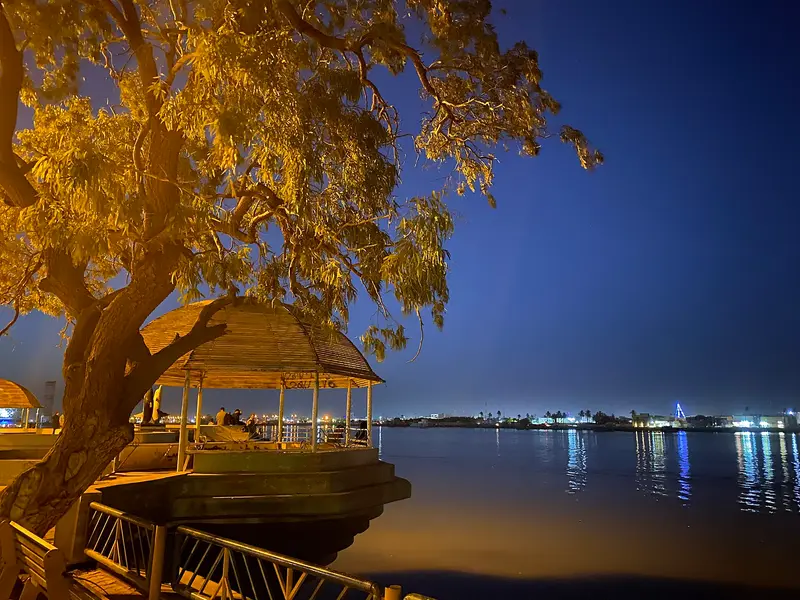
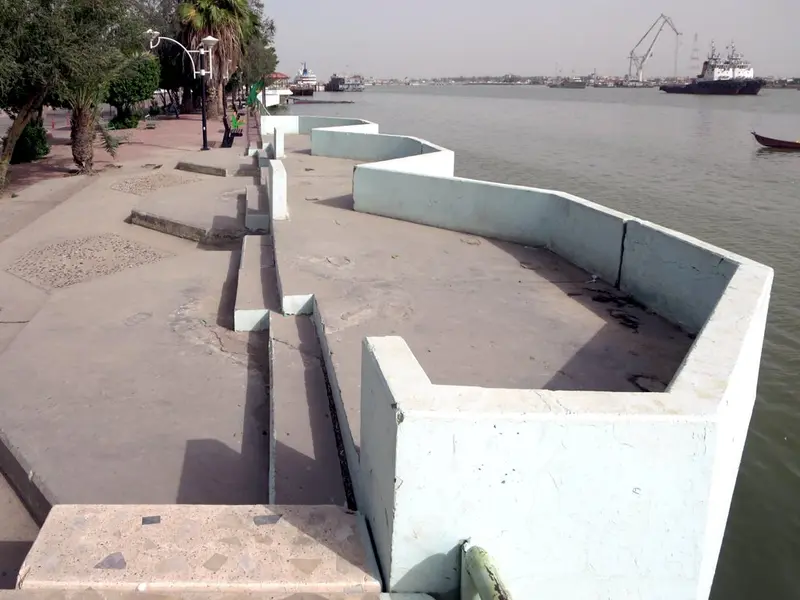
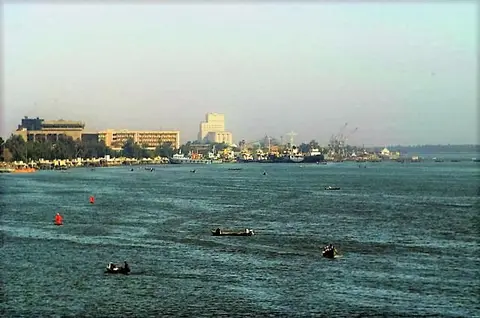
Basra Governorate sits at the southeastern tip of Iraq, bordered by Kuwait to the south and Iran to the east. The Shatt al-Arab — formed by the confluence of the Tigris and Euphrates rivers — runs through the city before emptying into the Gulf roughly 110 km downstream at Faw.
The governorate’s economy is built on two pillars: petroleum extraction and port logistics. The major producing oilfields lie to the north and northwest of the city (Rumaila, West Qurna, Majnoon and others), while the export and import infrastructure sits to the south — Umm Qasr port and the offshore oil terminals at Khor al-Amaya and Al-Basra Oil Terminal (ABOT) in the Gulf itself.
For a business visitor, Basra city is the hub from which everything else radiates. You will almost certainly pass through Basra International Airport and overnight in the city, even if your operational destination is a field camp or a port facility an hour’s drive away.
Umm Qasr port and Al-Maqal: location and transfer logistics
Umm Qasr is Iraq’s deepwater commercial port, located on a peninsula approximately 60 km south of Basra city, close to the Kuwaiti border. It is divided into an older northern section (Old Port) and a larger southern commercial complex (New Port). Virtually all bulk commodity imports — grains, construction materials, vehicles — and a significant share of oil product exports move through here.
Al-Maqal is a separate, older river-port district within Basra city itself, on the west bank of the Shatt al-Arab. It handled much of Basra’s historic trade and retains light cargo and ferry functions. If your meetings are in the Al-Maqal district rather than at Umm Qasr, you are working in a different location entirely — check with your host which facility they mean.
Transfer logistics between the city and Umm Qasr are arranged through your host company or a local driver. The road runs south along Highway 6 through the Zubair area. Travel time varies with traffic, road works and time of day; coordinate with your sponsor or driver for a realistic estimate rather than assuming a fixed duration. See Private drivers: daily rates and negotiation for practical advice on hiring a vehicle and driver for the day.
The major oilfields and industrial areas: a map-level orientation
The oilfield geography around Basra, at its simplest, looks like this:
- Southwest and west of the city (Zubair / Rumaila corridor): The Rumaila field complex — one of the world’s largest by reserve — stretches northwest of the city roughly parallel to the Kuwait border. The Zubair field lies between Rumaila and the city. The town of Az Zubayr (also written Zubair) is the administrative and logistics hub for much of this corridor.
- Northwest of the city (West Qurna area): West Qurna 1 and West Qurna 2 are located further north, in the direction of Nasiriyah, accessible via the main northern highway.
- Northeast, toward the Iranian border (Majnoon / Halfaya): Majnoon and Halfaya fields sit in and near the marshland zone to the northeast; the Mesopotamian Marshes overlap with this geography.
- Offshore: The deep-water export terminals (ABOT and KAAOT) are in the Gulf, accessible only by boat from Faw or by helicopter. Access is entirely controlled by the operator.
Industrial zones — including petrochemical plants, power stations and water treatment facilities — cluster around the Shatt al-Arab, Az Zubayr and the northern approaches to the city.
Note: This guide provides orientation only. No operational, production or infrastructure details are published here.
How access is arranged: permits, site visits and sponsor coordination
There is no public access to oilfields, port facilities or industrial zones. Every aspect of a site visit — gate passes, escort requirements, vehicle approvals, personal protective equipment standards, and photography rules — is set by the operating company and coordinated through your Iraqi sponsor or host entity.
What this means in practice:
- Your sponsor will initiate the permit process before you arrive. Confirm this is underway before you book flights.
- Bring multiple passport-sized photos and copies of your passport bio page; industrial sites routinely require them at the gate.
- Laptop and communication devices may be subject to inspection or surrender at certain facilities. Ask your host in advance.
- Do not attempt to visit any port, field or industrial site independently. Coordinate everything with your sponsor.
For visa and entry documentation, see the Visas & paperwork guidance and check with the Iraqi consulate in your country and your sponsor’s local PRO (public relations officer).
Where business visitors stay and meet
Most international business visitors are based either in Basra city (hotel accommodation) or in a company-operated field camp (accommodation provided by the operator — arrange through your host).
Basra city has a range of accommodation from international-branded mid-range hotels to local business hotels; see Where to stay in Basra for a structured overview. Meetings with local counterparts, government officials and service companies almost always take place in the city rather than at the field. Common venues are hotel lobbies, hotel business centers and company offices in the commercial districts.
For a practical introduction to the city before your first meeting, First 24 hours in Basra covers the basics of orientation.
Getting between the city, the port and field camps
Driver hire is the standard mode of transport for business visitors. You will rarely use public transport between the city and industrial sites. Your company may provide a driver; if not, hire through a reputable local operator — see Private drivers: daily rates and negotiation.
Key practical points:
- Agree on the full itinerary, waiting time and return journey with your driver before departure. Field gates often involve queuing; your driver will wait, but factor this into the day.
- For intercity travel (for example, if your itinerary includes Basra and then onward to Baghdad or Erbil by road), see Basra intercity bus and coach guide — though most business travelers use internal flights for longer legs.
- Basra International Airport is the main arrival and departure point; the airport arrival guide covers the arrival process in detail.
Weather reality: Business visits in summer require planning. Current forecasts (sourced from Open-Meteo, fetched 2026-07-20) show daytime highs reaching 47–48 °C this week, with overnight lows around 34–36 °C. Outdoor site work and travel between air-conditioned environments in this heat demands adequate hydration and appropriate clothing. July and August are consistently the peak heat months, with normal highs of 46 °C and effectively zero rainfall (Open-Meteo normals).
Practical etiquette and paperwork pointers for industrial visitors
Documentation to carry at all times:
- Passport (original, not a copy) — required at all checkpoints
- Visa or entry stamp documentation
- Company letter / invitation letter from your sponsor
- Any site-specific access badges issued by the operator
Etiquette basics:
- Business dress in Iraq is formal; a collared shirt and trousers are the minimum for office meetings. On-site, PPE requirements override personal dress preferences.
- Prayer times are observed — for reference, today’s Dhuhr prayer in Basra is at 11:55 and Asr at 15:33 (Aladhan API, fetched 2026-07-20). Schedule meetings with a buffer around midday and mid-afternoon.
- Bring business cards; exchanging them at the start of a meeting is standard.
- Alcohol is not available in most business and operational settings.
Money: The current exchange rate is approximately 1,309 IQD per USD (ExchangeRate-API, fetched 2026-07-20). US dollars are widely accepted in business contexts; for daily expenses see Money in Basra.
FAQ
Do I need a special visa to work in Basra’s oilfields?
Entry requirements depend on your nationality and the nature of your engagement. Your sponsor’s PRO and the Iraqi consulate in your country are the authoritative sources. Do not rely on general internet information — requirements change and your sponsor will have current guidance. Check with your sponsor and the official Iraqi government immigration portal before applying.
Can I visit Umm Qasr port without a company invitation?
No. Umm Qasr is an active commercial and strategic port. Access requires formal authorization coordinated through the operating authority and your host organization. There is no visitor or tourist access.
Where do most oil company offices have their Basra presence?
Most operating companies and major service firms maintain offices in Basra city, predominantly in the commercial districts and in hotels that offer meeting facilities. Your host will direct you to the right address; check with your counterpart before traveling to any office.
How do I get from Basra Airport to a field camp?
Your host company will arrange this. If you are joining a project, your company’s in-country logistics team will either send a vehicle to meet you at the airport or direct you to a designated pickup. Do not arrange independent transportation to a field camp without confirming access procedures with your sponsor first. See Basra Airport arrival guide for what to expect on arrival.
What should I do if my meeting is in the city but my site visit is the following day?
Plan to stay in the city overnight between your city meetings and your site visit. Attempting to do both in one day — particularly in summer heat — adds unnecessary pressure and is logistically unpredictable given gate wait times. See Where to stay in Basra for accommodation options.